An artisanal razor design with a story that cuts deep
With bead-blasted finishes, tight tolerances, and designs that are almost completely free of straight edges, Hone Shaving’s razors might seem to be manufactured as single pieces.
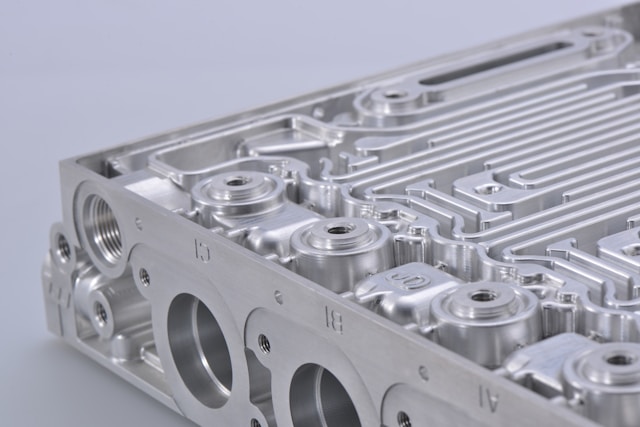
Their appearance, however, belies their intricacy; there are through holes, blind holes, thin slots, curves, and sophisticated internal assemblies. They are also three-piece units, consisting of a top cap and a guard bar–between which a straight razor is sandwiched–as well as a handle.
Hone Shaving’s razors are iconic heirloom pieces that are built to last for years upon years. There’s a personal reason behind the product’s inception. “The reason I started Hone was a loss in my family, and I was left with an object from that person,” Andrew Mitchell, Hone Shaving’s founder and sole proprietor, says.
A complex CNC machining process
“There’s a saying in design: ‘The simpler you go, the more complexity you have to hide’,” “That’s true of my product. I’m asking some quite challenging things of machined parts.”
Take the handle and guard bar, which must be fitted together in such a way that users can’t feel the split line between them when gripping the razor’s handle. Or the finishing on the top cap, which must provide some grip, but not so much as to prevent a smooth shave.
They are CNC-machined out of stainless steel, aluminum, and bronze, striking a fine balance between quality, finish, and price – and with profit margins that are, perhaps unsurprisingly, razor-thin.

Suitable for small or large volumes
“Previously I was dealing directly with CNC shops to manufacture them,” Mitchell said. “But a lot of the bigger manufacturers often don’t want to take on a job of machining a few hundred to a thousand pieces like this, especially from a demanding customer.”
There’s also the issue of bandwidth, Mitchell said. As a small company making a low-volume product, Hone Shaving doesn’t have much wriggle room if and when things go wrong. Run out of machine time or budget with a traditional machining shop, and your run is over, regardless of whether you’ve achieved the quality you desire.
Some of the machine shops Mitchell previously worked with tried unsuccessfully for more than a year to manufacture the parts he needed, leaving him feeling backed into a corner. Then things got worse.
“I had a manufacturer go into liquidation halfway into a production run that I’d already paid for,” Mitchell said. “I lost an entire production batch and the costs associated with it. The next one had to work, or I would have been in a troubled place with my business. The Protolabs Network team dug me out of a hole.”
Within two months of work with Protolabs Network, Mitchell was holding samples of the razors in hand. Three months after that, he had the final product.